


Page 101 - Volt Elevate The World Around Us Book 4
P. 101
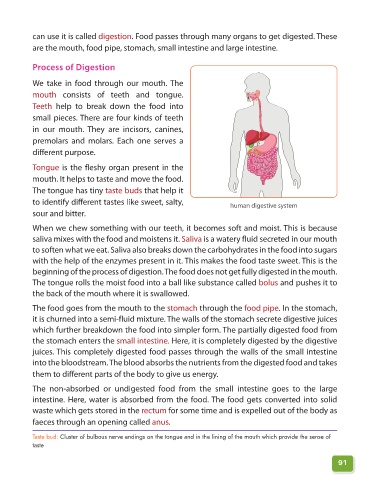
can use it is called digestion. Food passes through many organs to get digested. These

            are the mouth, food pipe, stomach, small intestine and large intestine.


            Process of Digestion

            We take in food through our mouth. The
            mouth  consists  of  teeth  and  tongue.

            Teeth help to break down the food into
            small pieces. There are four kinds of teeth

            in our mouth.  They are incisors, canines,
            premolars and molars. Each one serves a
            different purpose.

            Tongue is the fleshy organ present in the

            mouth. It helps to taste and move the food.
            The tongue has tiny taste buds that help it
            to identify different tastes like sweet, salty,                  human digestive system

            sour and bitter.

            When we chew something with our teeth, it becomes soft and moist. This is because
            saliva mixes with the food and moistens it. Saliva is a watery fluid secreted in our mouth
            to soften what we eat. Saliva also breaks down the carbohydrates in the food into sugars

            with the help of the enzymes present in it. This makes the food taste sweet. This is the
            beginning of the process of digestion. The food does not get fully digested in the mouth.
            The tongue rolls the moist food into a ball like substance called bolus and pushes it to
            the back of the mouth where it is swallowed.

            The food goes from the mouth to the stomach through the food pipe. In the stomach,

            it is churned into a semi-fluid mixture. The walls of the stomach secrete digestive juices
            which further breakdown the food into simpler form. The partially digested food from
            the stomach enters the small intestine. Here, it is completely digested by the digestive
            juices. This completely digested food passes through the walls of the small intestine

            into the bloodstream. The blood absorbs the nutrients from the digested food and takes
            them to different parts of the body to give us energy.

            The  non-absorbed  or  undigested food  from  the  small  intestine  goes  to  the  large
            intestine. Here, water is absorbed from the food. The food gets converted into solid

            waste which gets stored in the rectum for some time and is expelled out of the body as
            faeces through an opening called anus.

            Taste bud: Cluster of bulbous nerve endings on the tongue and in the lining of the mouth which provide the sense of
            taste

                                                                                                                 91

