


Page 54 - Volt Elevate The World Around Us Book 4
P. 54
Flowers


            Flowers add beauty to a plant. They are found in different sizes, shapes and colours.
            They may grow alone or in a bunch.


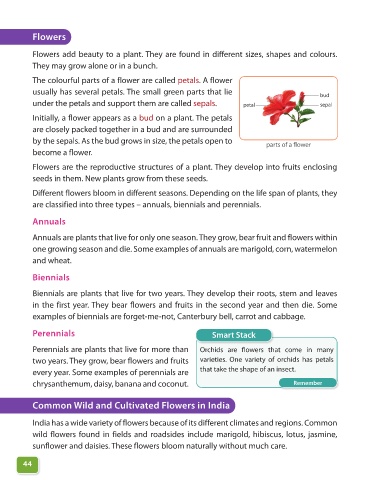
            The colourful parts of a flower are called petals. A flower
            usually has several petals. The small green parts that lie                                     bud
            under the petals and support them are called sepals.                  petal                    sepal

            Initially, a flower appears as a bud on a plant. The petals

            are closely packed together in a bud and are surrounded
            by the sepals. As the bud grows in size, the petals open to                  parts of a flower
            become a flower.

            Flowers are the reproductive structures of a plant. They develop into fruits enclosing

            seeds in them. New plants grow from these seeds.

            Different flowers bloom in different seasons. Depending on the life span of plants, they
            are classified into three types – annuals, biennials and perennials.

            Annuals


            Annuals are plants that live for only one season. They grow, bear fruit and flowers within
            one growing season and die. Some examples of annuals are marigold, corn, watermelon

            and wheat.

            Biennials

            Biennials are plants that live for two years. They develop their roots, stem and leaves

            in the first year. They bear flowers and fruits in the second year and then die. Some
            examples of biennials are forget-me-not, Canterbury bell, carrot and cabbage.


            Perennials                                                 Smart Stack

            Perennials are plants that live for more than          Orchids are flowers that come in many
            two years. They grow, bear flowers and fruits          varieties. One  variety  of orchids  has  petals

            every year. Some examples of perennials are            that take the shape of an insect.
            chrysanthemum, daisy, banana and coconut.                                             Remember


            Common Wild and Cultivated Flowers in India


            India has a wide variety of flowers because of its different climates and regions. Common
            wild flowers found in fields and roadsides include marigold, hibiscus, lotus, jasmine,

            sunflower and daisies. These flowers bloom naturally without much care.


         44

