


Page 75 - Volt Elevate The World Around Us Book 4
P. 75
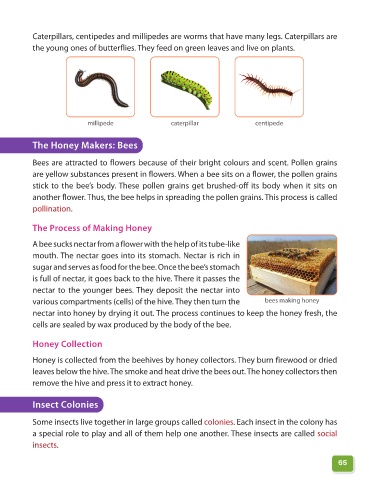
Caterpillars, centipedes and millipedes are worms that have many legs. Caterpillars are

            the young ones of butterflies. They feed on green leaves and live on plants.


                              millipede                   caterpillar                centipede


            The Honey Makers: Bees

            Bees are attracted to flowers because of their bright colours and scent. Pollen grains

            are yellow substances present in flowers. When a bee sits on a flower, the pollen grains
            stick to the bee’s body. These pollen grains get brushed-off its body when it sits on

            another flower. Thus, the bee helps in spreading the pollen grains. This process is called
            pollination.


            The Process of Making Honey

            A bee sucks nectar from a flower with the help of its tube-like

            mouth. The nectar goes into its stomach. Nectar is rich in
            sugar and serves as food for the bee. Once the bee’s stomach
            is full of nectar, it goes back to the hive. There it passes the

            nectar to the younger bees. They deposit the nectar into
            various compartments (cells) of the hive. They then turn the                 bees making honey

            nectar into honey by drying it out. The process continues to keep the honey fresh, the
            cells are sealed by wax produced by the body of the bee.


            Honey Collection

            Honey is collected from the beehives by honey collectors. They burn firewood or dried

            leaves below the hive. The smoke and heat drive the bees out. The honey collectors then
            remove the hive and press it to extract honey.


            Insect Colonies


            Some insects live together in large groups called colonies. Each insect in the colony has
            a special role to play and all of them help one another. These insects are called social

            insects.

                                                                                                                 65

