


Page 148 - Volt Elevate The World Around Us Book 4
P. 148
Changing Sky Colour During the Day


            The sky does not look the same colour all day. In the morning, during sunrise, the sky
            often looks orange, pink or red. As the sun rises higher, the sky becomes blue. At noon,
            the blue is the brightest because the sun is directly above us. In the evening, during

            sunset, the sky again turns orange, red or golden before becoming dark.


                          sunrise                          midday                           sunset

            This change of colours happens because of the sun’s light. Sunlight is made up of many

            colours and when it passes through the air, it scatters. During the day, blue light scatters
            the most which is why the sky looks blue. At sunrise and sunset, the sun is near the
            horizon, so its light travels through more air and dust. This scatters away the blue light

            and lets us see more red, orange and pink colours.


            The Role of the Atmosphere

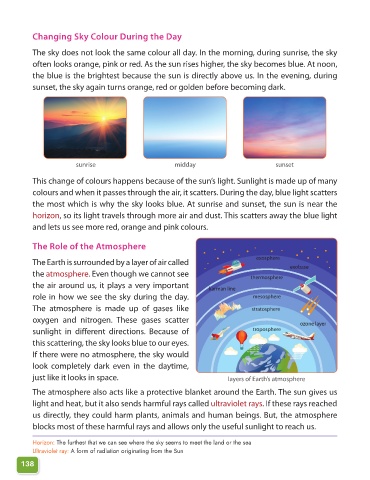
            The Earth is surrounded by a layer of air called                          exosphere
                                                                                                 exobase
            the atmosphere. Even though we cannot see
                                                                                    thermosphere
            the air around us, it plays a very important              karman line
            role in how we see the sky during the day.                               mesosphere
            The atmosphere is made up of gases like                                 stratosphere

            oxygen and nitrogen.  These gases scatter
                                                                                                    ozone layer
            sunlight in different directions. Because of                             troposphere

            this scattering, the sky looks blue to our eyes.
            If there were no atmosphere, the sky would
            look completely dark even in the  daytime,

            just like it looks in space.                                    layers of Earth’s atmosphere

            The atmosphere also acts like a protective blanket around the Earth. The sun gives us
            light and heat, but it also sends harmful rays called ultraviolet rays. If these rays reached
            us directly, they could harm plants, animals and human beings. But, the atmosphere

            blocks most of these harmful rays and allows only the useful sunlight to reach us.

            Horizon: The furthest that we can see where the sky seems to meet the land or the sea
            Ultraviolet ray: A form of radiation originating from the Sun

        138

