


Page 151 - Volt Elevate The World Around Us Book 4
P. 151
The Stars


            Stars are huge balls of gas that emit both heat and light. They appear as tiny dots that
            twinkle in the night sky. Stars come in different sizes. Some are small, while others are
            large. They vary in size because they are very far away from Earth.


            Stars seem to twinkle in the night sky because their light passes through layers of moving
            air in Earth’s atmosphere. The air bends the light slightly in different ways which makes
            the star’s brightness appear to change quickly.


            Constellations

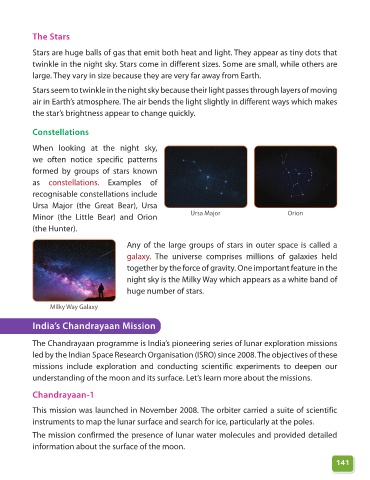
            When looking at  the night  sky,

            we often notice specific patterns
            formed  by groups  of stars  known
            as  constellations. Examples of

            recognisable constellations include
            Ursa Major (the Great Bear), Ursa

            Minor (the Little Bear) and Orion                   Ursa Major                      Orion
            (the Hunter).

                                           Any of the large groups of stars in outer space is called a

                                           galaxy.  The universe comprises millions of galaxies held
                                           together by the force of gravity. One important feature in the
                                           night sky is the Milky Way which appears as a white band of

                                           huge number of stars.

                  Milky Way Galaxy


            India’s Chandrayaan Mission


            The Chandrayaan programme is India’s pioneering series of lunar exploration missions
            led by the Indian Space Research Organisation (ISRO) since 2008. The objectives of these
            missions include exploration and conducting scientific experiments to deepen our

            understanding of the moon and its surface. Let’s learn more about the missions.

            Chandrayaan-1


            This mission was launched in November 2008. The orbiter carried a suite of scientific
            instruments to map the lunar surface and search for ice, particularly at the poles.

            The mission confirmed the presence of lunar water molecules and provided detailed
            information about the surface of the moon.

                                                                                                                141

