


Page 150 - Volt Elevate The World Around Us Book 4
P. 150
The Night Sky


            When the sun sets and slowly gets dark, we call it the night sky. It looks different from
            place to place and from season to season. Let’s learn about the moon and the stars

            visible in the night sky.

            The Moon


            The moon is Earth’s only natural satellite. It revolves around the Earth. It does not have
            light of its own.  It reflects the sun’s light. We call this moonlight.

            Surface of the Moon


            The surface of the moon is dusty and dry. It has bowl-shaped
            holes called craters, raised and low areas called mountains and
            valleys and large, smoother areas that look like grey patches

            called dark plains. The moon has no air or atmosphere of its
            own.
                                                                                           surface of moon
            Phases of the Moon

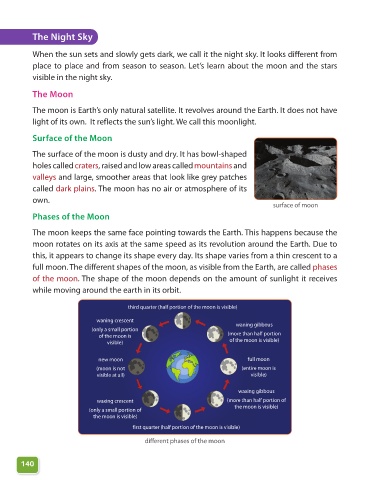
            The moon keeps the same face pointing towards the Earth. This happens because the
            moon rotates on its axis at the same speed as its revolution around the Earth. Due to

            this, it appears to change its shape every day. Its shape varies from a thin crescent to a
            full moon. The different shapes of the moon, as visible from the Earth, are called phases
            of the moon. The shape of the moon depends on the amount of sunlight it receives

            while moving around the earth in its orbit.


                                           third quarter (half portion of the moon is visible)
                                 waning crescent
                                                                               waning gibbous
                               (only a small portion
                                  of the moon is                            (more than half portion
                                    visible)                                 of the moon is visible)

                                  new moon                                         full moon
                                 (moon is not                                    (entire moon is
                                 visible at all)                                    visible)

                                                                                waxing gibbous
                                 waxing crescent                            (more than half portion of
                                                                               the moon is visible)
                               (only a small portion of
                                the moon is visible)
                                             first quarter (half portion of the moon is visible)

                                                 different phases of the moon


        140

