


Page 157 - Volt Elevate The World Around Us Book 4
P. 157
Although three-fourths of the earth’s surface is covered with water, only a very small

            portion of it can be used for drinking. This is because most of the water on the Earth is
            present in the seas and oceans which contain salty water. This water is not fit for drinking

            or other day-to-day activities.


            Sources of Water


            Rain

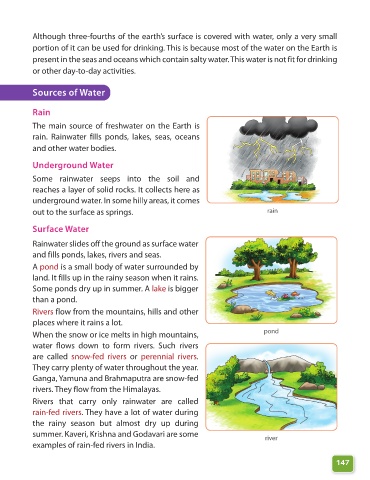
            The main source of freshwater on the Earth is
            rain. Rainwater fills ponds, lakes, seas, oceans

            and other water bodies.

            Underground Water

            Some rainwater seeps into the soil and
            reaches a layer of solid rocks. It collects here as
            underground water. In some hilly areas, it comes

            out to the surface as springs.                                               rain

            Surface Water

            Rainwater slides off the ground as surface water
            and fills ponds, lakes, rivers and seas.

            A pond is a small body of water surrounded by
            land. It fills up in the rainy season when it rains.
            Some ponds dry up in summer. A lake is bigger

            than a pond.
            Rivers flow from the mountains, hills and other
            places where it rains a lot.

            When the snow or ice melts in high mountains,                               pond
            water flows down to form rivers. Such rivers
            are called  snow-fed rivers  or  perennial rivers.

            They carry plenty of water throughout the year.
            Ganga, Yamuna and Brahmaputra are snow-fed
            rivers. They flow from the Himalayas.

            Rivers that carry only rainwater are called
            rain-fed rivers. They have a lot of water during
            the rainy season but almost dry up during
            summer. Kaveri, Krishna and Godavari are some                                river

            examples of rain-fed rivers in India.

                                                                                                                147

