


Page 159 - Volt Elevate The World Around Us Book 4
P. 159
Some examples of evaporation in our daily life are given below.

                   y Sweat from our body dries up due to evaporation.
                   y Wet clothes dry when we put them in the sun and the water evaporates from them.

                   y  Salt is also extracted from seawater using the process of evaporation. Dykes are
                   made on the shore to prevent seawater from flowing back into the sea. These areas
                   with dykes are called salt pans. The water in these pans gradually evaporates leaving
                   a layer of salt behind. This is the salt we eat after it is refined in the factories.

            Condensation

            On cooling, water vapour changes back to droplets of water. This is called condensation.
            When we boil water in a kettle, we can see steam (water vapour) coming out from its
            nozzle.
            If we place a plate in front of the nozzle, we will find water droplets
            on the surface of the plate facing the steam. This is condensation.

            Dew drops on leaves in winter is an example of condensation in
            our daily life.
                                                                                           condensation of steam
            Water Cycle

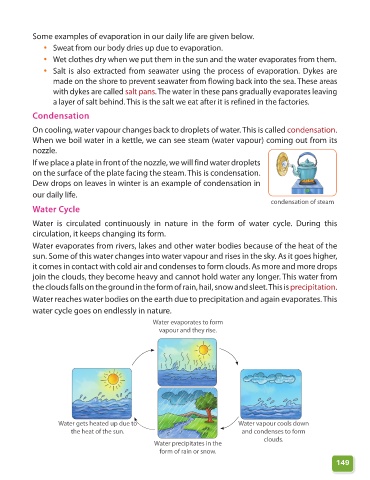
            Water  is  circulated  continuously  in  nature  in  the  form  of  water  cycle.  During  this
            circulation, it keeps changing its form.

            Water evaporates from rivers, lakes and other water bodies because of the heat of the
            sun. Some of this water changes into water vapour and rises in the sky. As it goes higher,
            it comes in contact with cold air and condenses to form clouds. As more and more drops
            join the clouds, they become heavy and cannot hold water any longer. This water from
            the clouds falls on the ground in the form of rain, hail, snow and sleet. This is precipitation.

            Water reaches water bodies on the earth due to precipitation and again evaporates. This
            water cycle goes on endlessly in nature.

                                                    Water evaporates to form
                                                      vapour and they rise.


                    Water gets heated up due to                                 Water vapour cools down
                         the heat of the sun.                                    and condenses to form
                                                                                        clouds.
                                                    Water precipitates in the
                                                      form of rain or snow.
                                                                                                                149

