


Page 161 - Volt Elevate The World Around Us Book 4
P. 161
the object and the density of water. If the object is less dense than water, it floats. If the

            object is denser than water, it sinks. This floating and sinking also depends on a force
            called buoyant force, which is the upward push water gives to objects.

            Floating Objects


            Objects float in water when they are
            lighter or less dense than water. For

            example, a wooden stick, a piece of
            plastic or a dry leaf will float easily. Some
            objects float even if they are very large.

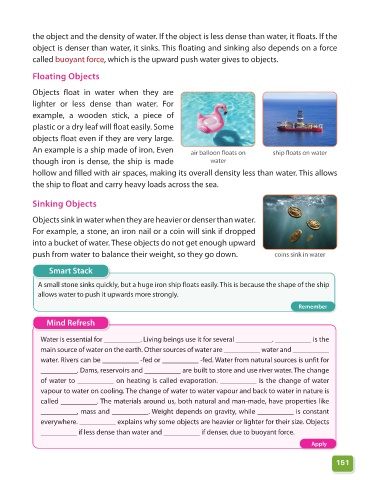
            An example is a ship made of iron. Even             air balloon floats on      ship floats on water
            though iron is dense, the ship is made                     water
            hollow and filled with air spaces, making its overall density less than water. This allows

            the ship to float and carry heavy loads across the sea.


            Sinking Objects

            Objects sink in water when they are heavier or denser than water.

            For example, a stone, an iron nail or a coin will sink if dropped
            into a bucket of water. These objects do not get enough upward
            push from water to balance their weight, so they go down.                       coins sink in water


                 Smart Stack

              A small stone sinks quickly, but a huge iron ship floats easily. This is because the shape of the ship
              allows water to push it upwards more strongly.
                                                                                                    Remember


                Mind Refresh

              Water is essential for __________. Living beings use it for several __________. __________ is the
              main source of water on the earth. Other sources of water are __________ water and __________
              water. Rivers can be __________ -fed or __________ -fed. Water from natural sources is unfit for
              __________. Dams, reservoirs and __________ are built to store and use river water. The change

              of water to __________ on heating is called evaporation. __________ is the change of water
              vapour to water on cooling. The change of water to water vapour and back to water in nature is
              called __________. The materials around us, both natural and man-made, have properties like
              __________, mass and __________. Weight depends on gravity, while __________ is constant
              everywhere. __________ explains why some objects are heavier or lighter for their size. Objects
              __________ if less dense than water and __________ if denser, due to buoyant force.

                                                                                                        Apply

                                                                                                                151

