


Page 130 - Volt Elevate The World Around Us Book 4
P. 130
11              The Land We Live In


                                                                                                  Explore More
                                                    About the Chapter

              The chapter introduces us to the different types of landforms and monuments of India. The Earth’s
              surface is not the same everywhere; it has mountains, plateaus, plains, deserts, coasts and islands,
              each with unique features and challenges. Mountains like the Himalayas are home to valleys,
              while plateaus such as the Deccan Plateau have flat tops. The fertile Ganga and Indus Plains are
              the food bowls of India, while the Thar Desert faces water scarcity. The coastal plains stretch along
              the sea and the islands are surrounded by water. The chapter also describes famous monuments
              and places such as the Amarnath Cave, Nanda Devi National Park, Gol Gumbaz, Ajanta and Ellora
              Caves, Taj Mahal, Golden Temple, Konark Sun Temple, Puri Jagannath Temple, Gateway of India
              and Cellular Jail. It further explains the challenges faced by people in each landform, along with
              the traditional food and attire that reflect the climate, geography, and culture of those regions.


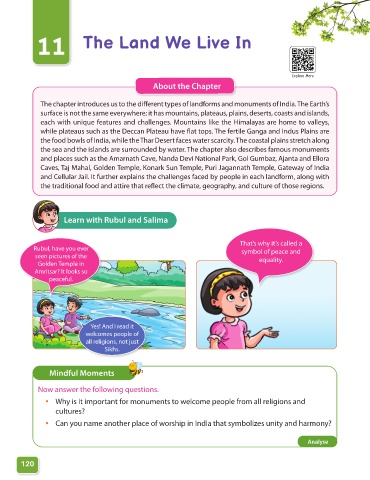
                      Learn with Rubul and Salima


                                                                                That’s why it’s called a
            Rubul, have you ever                                                 symbol of peace and
             seen pictures of the                                                      equality.
              Golden Temple in
             Amritsar? It looks so
                 peaceful.


                               Yes! And I read it
                             welcomes people of
                             all religions, not just
                                    Sikhs.


                 Mindful Moments

              Now answer the following questions.

                   y Why is it important for monuments to welcome people from all religions and
                   cultures?
                   y Can you name another place of worship in India that symbolizes unity and harmony?


                                                                                                       Analyse


        120

