


Page 83 - Volt Elevate The World Around Us Book 4
P. 83
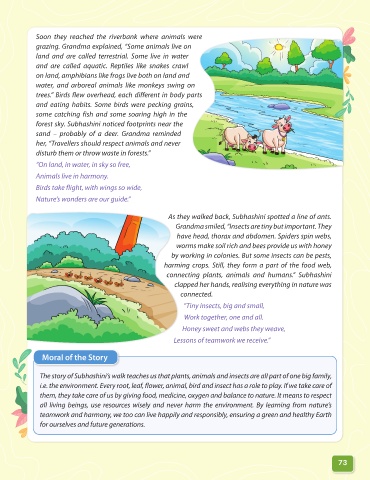
Soon  they  reached  the  riverbank  where  animals  were
             grazing. Grandma explained, “Some animals live on
             land and are called terrestrial. Some live in water
             and are called aquatic. Reptiles like snakes crawl
             on land, amphibians like frogs live both on land and
             water, and arboreal animals like monkeys swing on
             trees.” Birds flew overhead, each different in body parts
             and eating habits. Some birds were pecking grains,
             some catching fish and some soaring high in the
             forest sky. Subhashini noticed footprints near the
             sand – probably of a deer. Grandma reminded
             her, “Travellers should respect animals and never
             disturb them or throw waste in forests.”
             “On land, in water, in sky so free,
             Animals live in harmony.

             Birds take flight, with wings so wide,
             Nature’s wonders are our guide.”


                                                         As they walked back, Subhashini spotted a line of ants.
                                                           Grandma smiled, “Insects are tiny but important. They
                                                            have head, thorax and abdomen. Spiders spin webs,
                                                           worms make soil rich and bees provide us with honey
                                                          by working in colonies. But some insects can be pests,
                                                       harming crops.  Still, they form a part  of the food web,
                                                        connecting plants, animals and humans.” Subhashini
                                                           clapped her hands, realising everything in nature was
                                                             connected.
                                                              “Tiny insects, big and small,
                                                              Work together, one and all.

                                                             Honey sweet and webs they weave,
                                                           Lessons of teamwork we receive.”


               Moral of the Story


              The story of Subhashini’s walk teaches us that plants, animals and insects are all part of one big family,
              i.e. the environment. Every root, leaf, flower, animal, bird and insect has a role to play. If we take care of
              them, they take care of us by giving food, medicine, oxygen and balance to nature. It means to respect
              all living beings, use resources wisely and never harm the environment. By learning from nature’s
              teamwork and harmony, we too can live happily and responsibly, ensuring a green and healthy Earth
              for ourselves and future generations.


                                                                                                                 73

